The Last Jedi
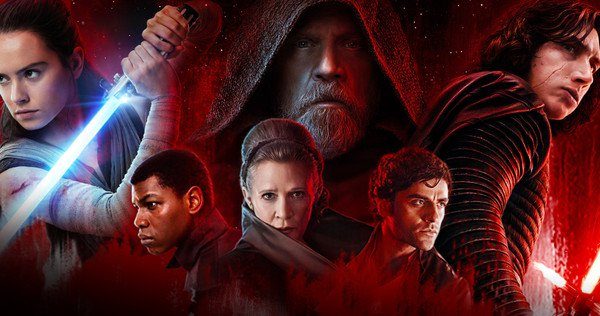
I grabbed my bag of smuggled sour patch kids out of my pocket as soon as the movie theater worker went out of my line of sight. I had been waiting for a long time to see what happens in the new Star Wars movie, which is why I eagerly started munching on my candy, feeling like the movie already started even though the previews were just beginning. Sitting in my chair, voices around me buzzed with excitement, children and their parents whispering their own theories about what was going to happen. And then the movie started. And from that first sequence to the last I felt a continually growing disappointment that I admit with embarrassment amounted at several points into outright anger. But, after thinking about it for a couple of days, I think I can at last give a reasonable account of what exactly disappointed me in Star Wars: The Last Jedi. And by the way, there are SPOILERS in this review.
Pacing
Often times when this word is used in regards to a movie it is used with an annoying looseness to it that gives the average movie goer the impression that it is one of those words people use to feel smart. But by 'pacing' I mean only something that most people feel without having to talk about it; it is the flow of a movie. From the director's viewpoint, it is the choice he/she makes in putting certain scenes at certain places rather than other places. As such, pacing is by its nature something that in some ways is 'larger' than any particular scene. It is an irreducible aspect of the overarching story being told, and gives scenes that are particular in nature a sense of unity.
The pacing in The Last Jedi failed in several ways. Every complaint has one aspect in common though: the way the scenes were sequenced seemed to always amount to a conflict in tone. The best example I can give of this phenomenon occurs in what I take to be the intended climax of the movie. Kylo Ren and Rey are battling Snoke's guards and Holdo is about to ram the rebel starship into the enemy's starship as an act of sacrifice. What I took Rian Johnson (the director of this movie) to be attempting was to have two suspenseful storylines serve the converging function of creating tension. And it would have worked if only they ever converged.
There are specific ways in which the placement of scenes in this climax sequence failed to juice the most out of its potential and resulted in tonal inconsistency. When Kylo Ren split Snoke in two and is fighting Snoke's guards with Rey at his side, Johnson cut to Leia escorting Poe onto an evacuation ship and emotionally saying goodbye to Holdo. When Holdo finally blasts into the enemy starship, Kylo Ren and Rey have already defeated Snoke's guards and are now undergoing a new challenge: that of trying to convince the other to join their cause. Instead of each storyline building on the other's suspense, they confuse the other's suspense.
The odd choice of scene placement in this specific part of the movie's chronology is symptomatic of problems in the general chronology of the movie. By the time the rebels reach the abandoned rebel base on the last planet, I felt ready for a resolution. In fact, I needed a resolution. So much had happened that I was looking for characters to emotionally recognize what had just happened. But instead of choosing to resolve the story here, Johnson for some reason added another climax in the form of a battle on the planet's surface and a light saber duel between Luke and Kylo Ren. Which brings me to my second complaint, so perfectly exhibited in the way this movie handled the death of Luke.
Lack of Emotional Resonance
The more and more momentous events occurred in the story the more and more I felt frustrated at the absence of events that facilitate the emotional resonance necessary for anchoring the importance of momentous events. What do I mean? A perfect example that I used to transition into this heading is found in the death of Luke.
After Luke fought Kylo Ren and, much to the surprise of the audience, didn't die despite being stabbed with a lightsaber, he did in fact die in a rather confusing way at the end of that sequence nonetheless. I still remember almost laughing at how ludicrous it was to at once go from shock that Luke was in fact not only alive, but floating above a rock back on his lonely island, to then seeing him stare off at something in the sunset and without any explanation or emotional contribution to the story just poof away. Beyond the really unsatisfying role that Luke played in the story (what did he teach Rey again?), the way his death was dealt with in the story shows a deeper problem with the story as a whole. For after our beloved Luke just poofed away (perhaps symbolizing how air-thin his presence was in this story), the only emotional recognition of this fact in the story itself was two hasty headshots and Rey telling a perfectly calm and unburdened Leia that she felt Luke's spirit was no more.
As to why Leia, Luke's sister, wouldn't be the one telling Rey this, and as to why Luke's death wouldn't affect the mood of his companions in the story and the story itself to a greater degree is beyond me. It is flat-out annoying. And again, it stands as but one example among many of a common phenomenon in the story. Rey never seems to learn anything from Luke in a way that sticks. The entire interaction between Poe and Holdo literally is a result of the latter not interacting with the former. The relationship between Finn and Rose feels heartless and pointless (as does their entire side adventure, which by coincidence, is in fact pointless). There is a severe absence of genuine interaction in this movie, of connective events that reveal what each character is feeling and gaining from the story they a part of. Even points where the movie tries to show emotional responsiveness feels like it's thrown in (Poe's reaction to Holdo's sacrifice, Finn suddenly claiming to be a full-blown rebel to the point of willing to sacrifice himself, Rose expressing romantic intension towards Finn, etc.). And points that genuinely succeed in this regard (i.e., the interactions between Rey and Kylo Ren, the interaction between Luke and Leia before Luke (or I should say ghost Luke) goes out without satisfying explanation to face to Kylo Ren), all suffer from the failed attempts and noise that crowds heartfelt moments and pollutes emotionally charged tones.
Now all of this leads into another complaint: Rian Johnson's uncontrolled experimentation (or we might say, his uncontrolled creative additions) resulted in losing the foundation set up by the preceding movies.
Losing the Past
It is not a bad thing to experiment. But unfortunately the connotation 'experimentation' has carried with it is one moving away from the past. This too of course might have its benefits, but it must have its point. I do not doubt Rian Johnson had a point to his experimentation (and I think it could have worked well if the before mentioned problems were amended), but it seems that that is all he had, besides of course that tendency to associate experimentation with moving away from old truths. As is common when the two are combined, it seems that Rian Johnson really left things in greater confusion rather than greater clarity.
I could simply list all the things Rian Johnson not only failed to fulfill but effectively succeeded in truncating from the previous Star Wars installments. The character of Snoke was tonally built to be of mysterious importance in the former movie, and here, while the unexpected murder of Snoke was praiseworthy, it didn't amount to its highest fulfillment in the story since the mystery of Snoke's identity as laid out in The Force Awakens was never fulfilled; in fact, it was wholeheartedly ignored. The question of Rey's parents was answered (presumably) by Kylo Ren in a completely deflationary manner that makes the entire journey of Rey feel inconsequential in a way (especially since we never see how this fact affects Rey's character arc). The mystery of how Maz has Luke's light saber is not only never hinted at, but flatly never brought up.
The sheer willingness to ignore what was taken to be important in the previous installment is astounding. It feels rude, assaulting, uncaring, etc. It feels like Rian Johnson got a hold of some eliminativist manifesto and went to town rejecting what sane people recognize as being central to the very character of the subject-matter in question. If Rian Johnson preferred to say that all these mysteries are really actually plain facts of no consequence, then let him do so. But for most he doesn't even bother mentioning them, and for those he does mention, he doesn't bother showing the effect of making mysteries nothing more than plain fact has on the characters in the story and on the story itself.
Final Remarks
Despite what this review might sound like it's trying to say, I think that, far from hating this movie, I feel mostly frustrated by it. I think it had the potential to be something incredible. The simple enough replacement of certain scenes accompanied by the choice to include more scenes of a certain kind and less of another kind would have made this movie something like another Empire Strikes Back. But as it remains, it feels terribly wasted. There a several things I didn't even mention about it that bothered me, such as the mistimed and misplaced humor that takes the audience out of the movie, the lack of John Williams, and the unfailing failure to maturely develop character arcs (all these no doubt are problems that follow upon the aforementioned problems). But all that I could say against this movie doesn't deteriorate moments where I found myself open-mouthed in awe, or giddy with excitement, or chewing even more feverishly on my sour patch kids.
Comments
Post a Comment